

How To Draw A Pareto Chart
Pareto diagrams are not hard to construct. With a estimator, graph paper, and a sharp pencil (or even better, a computer with spreadsheet and charting software), an comeback team can hands produce Pareto diagrams to help in decision making.
Getting Ready
As with all the analytical tools, a good Pareto diagram starts with good data. In this case, the data that is needed is any mensurate of quality, stratified by the various categories that contribute to the overall event.
The measure of quality can be anything that the squad agrees will quantify the negative touch on of the result under consideration. Typical measures include: Cost, fourth dimension, number of errors or failures, per centum of customers expressing an stance, etc.
The mensurate (e.g., cost) must be the aforementioned for all contributors in the analysis. Pareto analysis is a measured and ranked comparison. Yous cannot rank past different measures on the same Pareto table or diagram; that would be "comparison apples to oranges."
Make certain that you spend time identifying all of the potential contributors before you gear up out to get together the data. Otherwise, you may end up with "miscellaneous" or "unclassified" items. It does not help to focus your squad's efforts if one of the "vital few" is titled "miscellaneous."
The list of contributors to the effect can come up from a diversity of sources: Group brainstorming sessions, cause-consequence diagrams, process menstruum diagrams, or the data itself.
Sometimes, the data you demand already exists in accounting systems, routine management reports, or the files of individuals in the organisation. If, however, the data does not exist, your team should develop a means for gathering it.
No matter how you develop the raw data for your Pareto assay, to be successful, your data must:
- Use facts, not opinions, every bit the ground for determination making.
- Use the aforementioned measure out for all contributors, and use the same assumptions and calculations throughout. Keep in mind that Pareto assay is a comparison technique. As well note that consistency is more than important than absolute precision in the numbers. It does not matter so much if assumptions and price estimates are, say, conservative throughout by ten percent; equally long as they stay consistent across all categories, the comparisons will withal yield the right "vital few."
- Make sure your data represents the actual weather condition and situations in the procedure.
- Avoid controversial assumptions or techniques. Go on in mind that you are using Pareto assay to back up decision making. If people do not believe the information, they volition not support your team's decision.
- Be artistic!
Steps to Construct a Pareto Diagram
The following case will brandish the steps to construct a Pareto Diagram.
A team wanted to reduce the number of billing bug. Customer service reps were asked to record the blazon of defects (or billing issues) for each customer telephone call during a one-week study period. At the stop of the week, the squad collected the checksheets and tallied the results past specific cause. To build the Pareto, they followed these steps:
Step 1: Total the data on event of each contributor, and sum these to determine the 1000 total.
| Defect Blazon | # Queries |
| Accost Wrong | 8 |
| Time Incorrect | twenty |
| Rate Factor Incorrect | 4 |
| Service Coding Incorrect | 32 |
| Format Confusing | 6 |
| Payment Not Credited | 3 |
| 73 |
Stride 2: Re-society the contributors from the largest to the smallest.
| Defect Type | # Queries |
| Service Code Incorrect | 32 |
| Time Incorrect | 20 |
| Address Wrong | 8 |
| Format Confusing | 6 |
| Rate Factor Incorrect | iv |
| Payment Not Credited | three |
| 73 |
Footstep 3: Make up one's mind the cumulative-percent of total.
For instance, the cumulative-percent of total through the fifth contributor is the sum of the effects of the first five in rank ordering, divided by the yard total, and multiplied by 100.
[(32+20+8+6+iv)/73]x100=(seventy/73)x100=96%
The resulting table is called the Pareto Table.
| Defect Blazon | # Queries | Cumulative % |
| Service Code Wrong | 32 | 44% |
| Time Incorrect | 20 | 71% |
| Accost Wrong | 8 | 82% |
| Format Confusing | six | 90% |
| Rate Factor Incorrect | 4 | 96% |
| Payment Not Credited | 3 | 100% |
| 73 |
Step 4: Depict and label the left vertical centrality.
- Label the axis from zero to the grand total or just across.
- Provide a explanation to describe the measure out being used.
Pace five: Describe and label the horizontal centrality.
- Divide the axis into equally many divisions as there are contributors.
- Listing the contributors from largest to smallest, going from left to right.
- Provide a explanation to describe them.
- If the contributor names are long, label the axis A, B, C, etc. and provide a separate cardinal.
Footstep 6: Draw and label the right vertical axis.
- Label the axis from zero to 100 percent.
- Line up 100 percentage with the grand total on the left axis. In this example, the grand total is 73, so the 50 per centum point on the right centrality should line up with 36.5 on the left axis.
- (50/100)x73=36.5
- Provide the caption: "Cumulative-Pct of Total."
Step seven: Draw confined to represent the magnitude of each contributor's effect.
The top of the confined corresponds to the magnitude of that contribution as measured on the left centrality.
Step eight: Depict a line graph to stand for the cumulative-percent of total.
- The plotted points stand for to the cumulative-percent equally measured on the correct centrality.
- Line upward the points to a higher place the right-hand edge of the confined.
- The cumulative-percent-of-total betoken for the first ranked contributor should be fifty-fifty with the height of the first bar. If not, you accept made an fault.
Step nine: Clarify the diagram.
Look for a breakpoint on the cumulative-percent graph.
Step 10: Title the nautical chart, label the "vital few" and "useful many", and show the cumulative-percent contribution of the vital few.
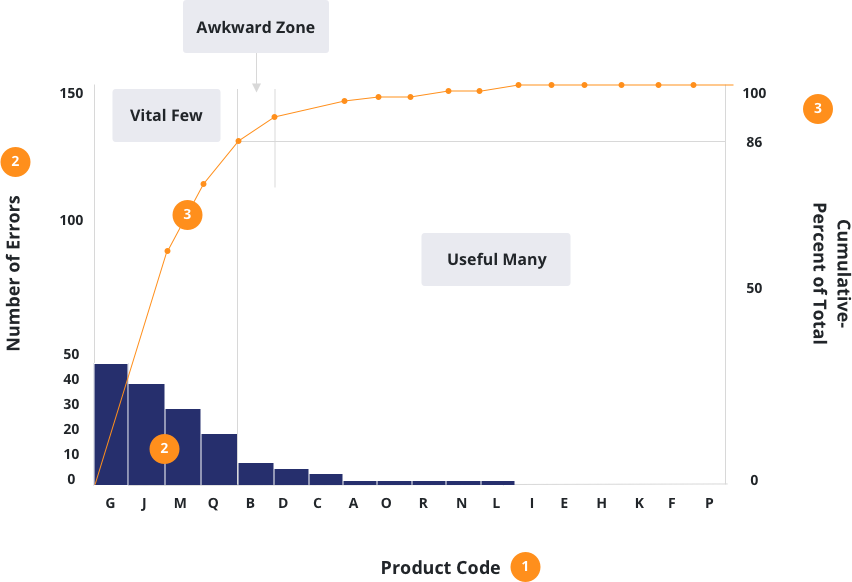
Read our guide on the Pareto Principle and Pareto Analysis for more data on these key quality comeback concepts.
For more than information on Pareto Diagrams and how Juran tin can assist you leverage them to improve business organisation quality and productivity, please arrive touch with the team.
Resources
Recommended Reading

Source: https://www.juran.com/blog/how-to-construct-a-pareto-diagram/
Posted by: hernandezsuccans.blogspot.com
0 Response to "How To Draw A Pareto Chart"
Post a Comment